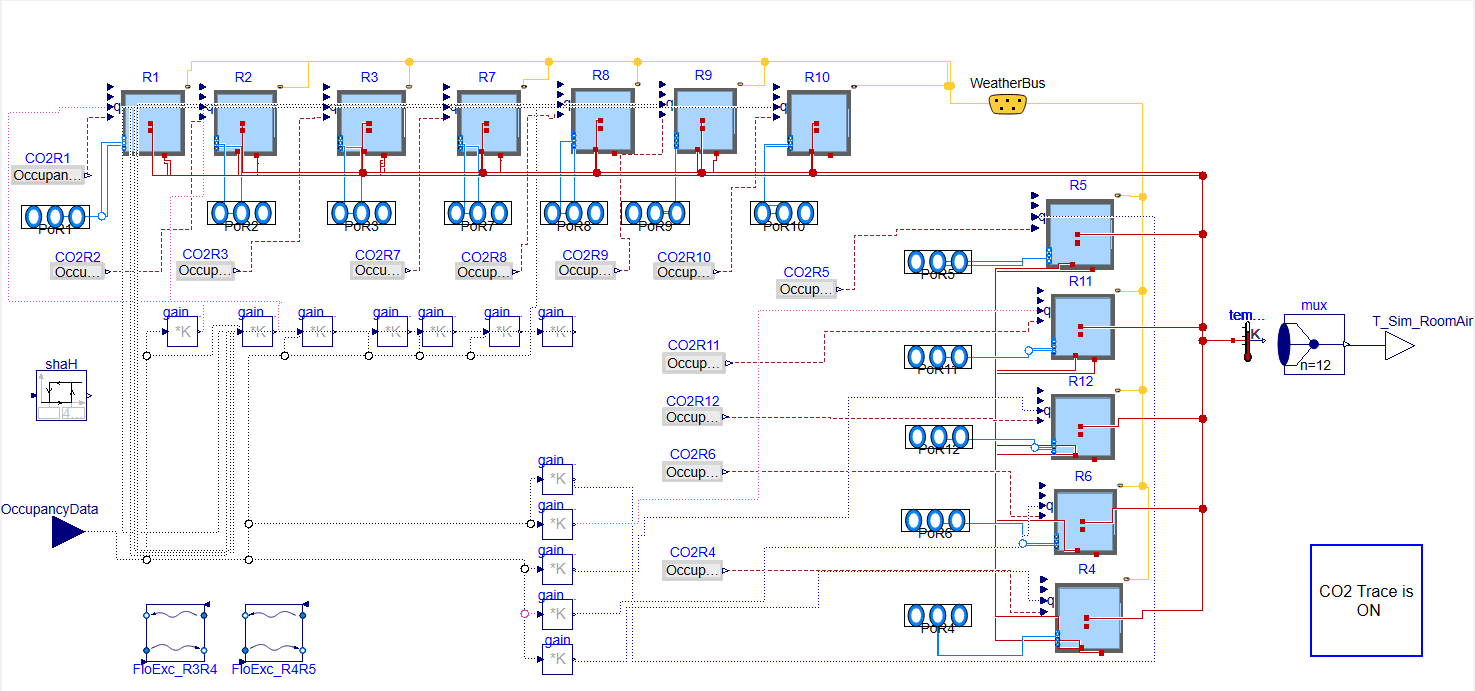
Generated base model of the studied floor in the office building .
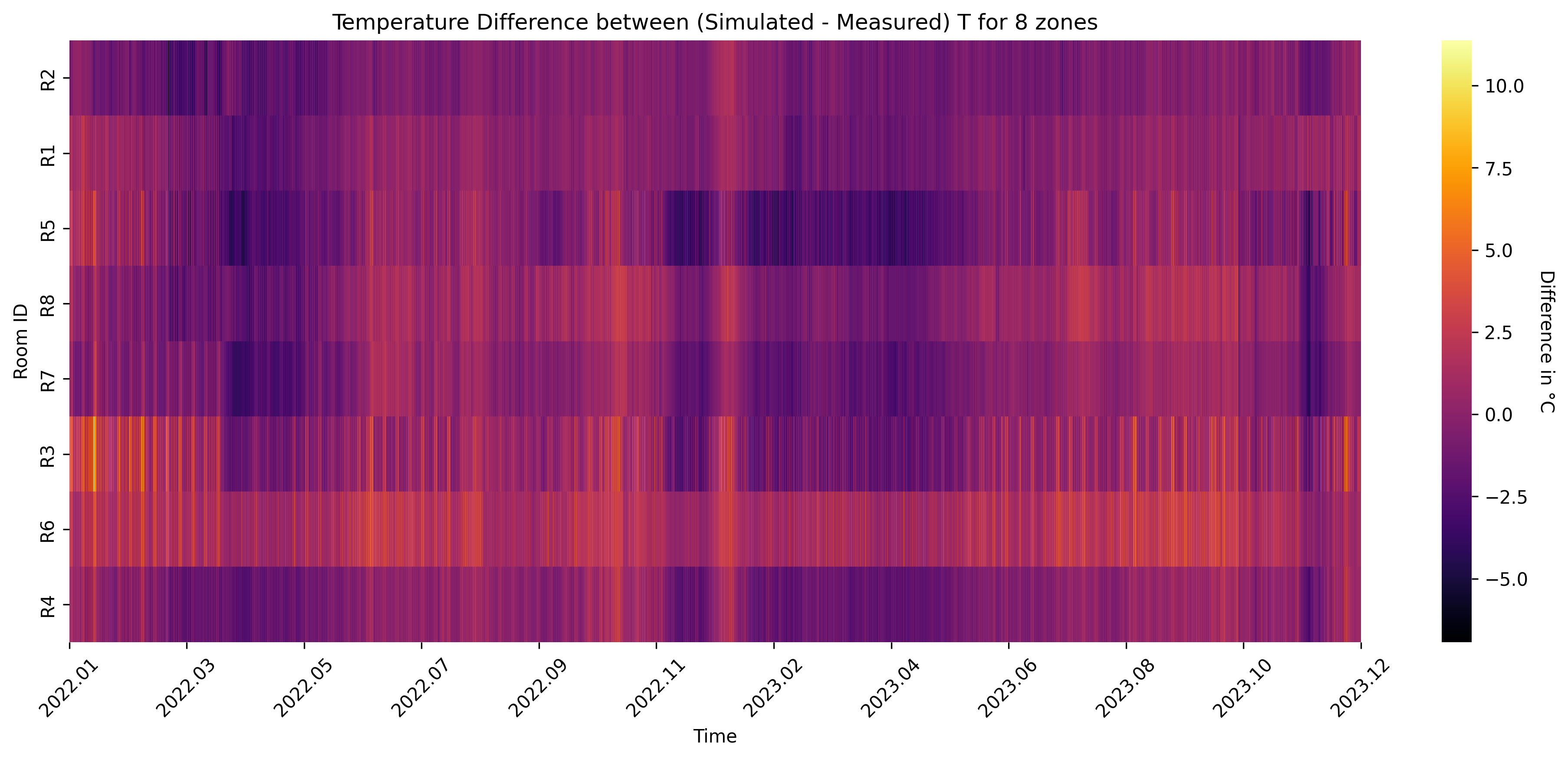
Heatmap of the root mean square error between simulated and measured room temperature.
Building Performance Simulation (BPS) models are often used as test benches to optimize the operation of Heating, Ventilation, and Air-Conditioning (HVAC) systems in buildings. Since modelling a building and its HVAC systems demands intensive manual efforts, existing studies have explored generating BPS models semi-automatically using Industry Foundation Classes (IFC) files. However, such an approach focuses primarily on modelling the building envelope with a simplified system during the design stage because the IFC schema still lacks the vocabulary to describe the technical equipment, their control sequences, and sensor da-ta comprehensively. This paper investigates how data transfer relying on Semantic Web technologies can reduce the modelling efforts in BPS. The metadata required in simulation, which includes building topology, HVAC systems, related sensors, and actuators, is described in the Resource Description Framework (RDF). The paper proposes a semantic graph-based workflow to generate a model consisting of building envelope and HVAC systems and then connect the model with the corresponding historical measurements. The workflow successfully generates a twelve-zone office building model with a simplified HVAC system. The CO2 and temperature simulation results of all zones are compared with real measurements from 2022 -- 2023. This study demonstrates RDF-based approach can largely reduce the manual efforts required in configuring the BPS models, especially during the building operation stage.
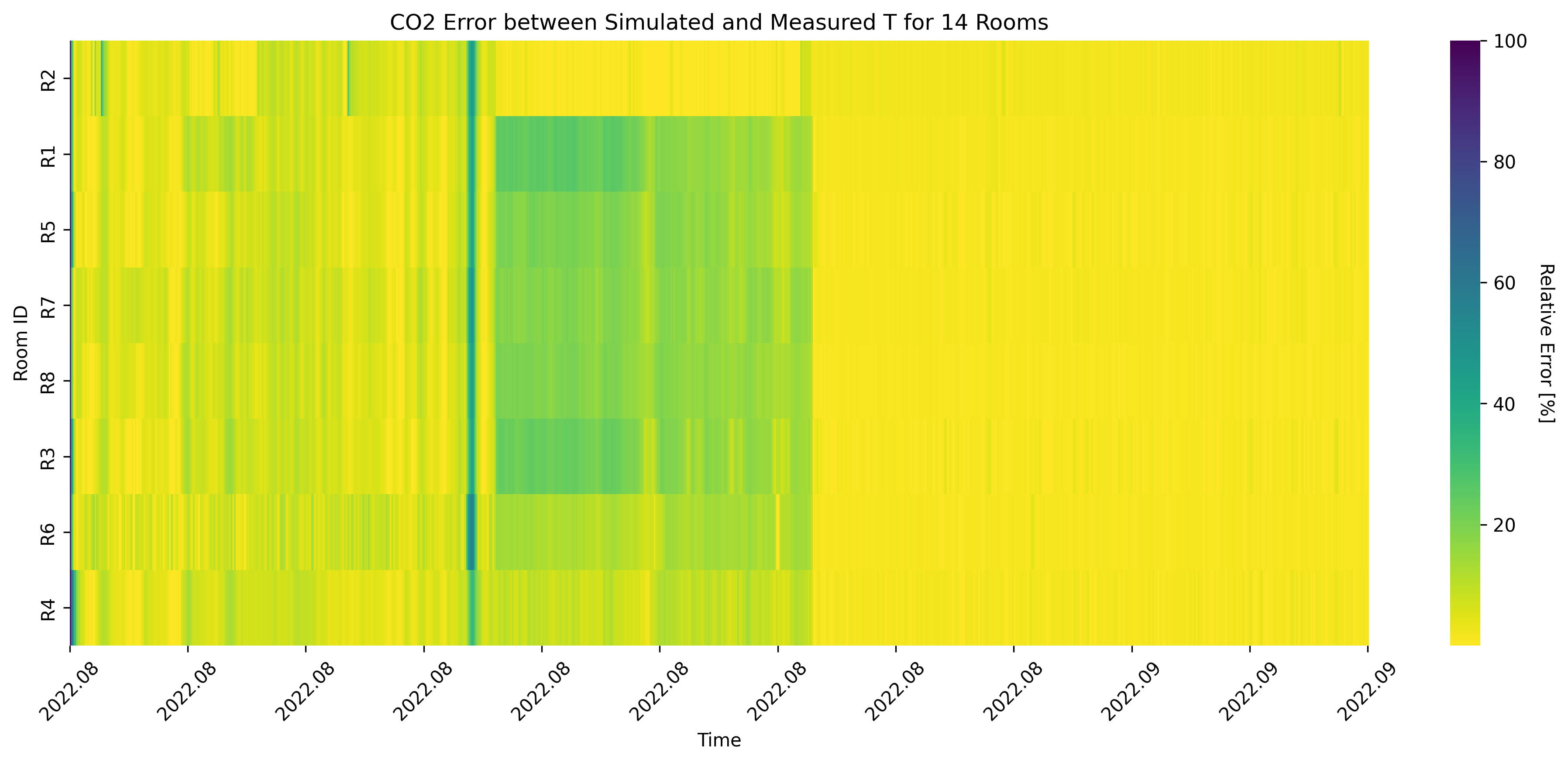
The developed workflow is tested on part of an office building at Bosch Research Campus. The BPS model of the first floor of the building, which consist of twelve zones, was successfully generated. Due to lack of sensors in Room 9, 10, 11 and 12, the simulation results are only compared in Room 1 to Room 8, as displayed below.
                  @inproceedings{a022f29abcba4ae8a49a0d75cb553548,
                  title = "Generating building performance simulation models using semantic graphs and sensor measurements",
                  abstract = "Building Performance Simulation (BPS) models are often used as test benches to optimize the operation of Heating, Ventilation, and Air-Conditioning (HVAC) systems in buildings. Since modelling a building and its HVAC systems demands intensive manual efforts, existing studies have explored generating BPS models semi-automatically using Industry Foundation Classes (IFC) files. However, such an approach focuses primarily on modelling the building envelope with a simplified system during the design stage because the IFC schema still lacks the vocabulary to describe the technical equipment, their control sequences, and sensor data comprehensively. This paper investigates how data transfer relying on Semantic Web technologies can reduce the modelling efforts in BPS. The metadata required in simulation, which includes building topology, HVAC systems, related sensors, and actuators, is described in the Resource Description Framework (RDF). The paper proposes a semantic graph-based workflow to generate a model consisting of building envelope and HVAC systems and then connect the model with the corresponding historical measurements. The workflow successfully generates a twelve-zone office building model with a simplified HVAC system. The CO2 and temperature simulation results of all zones are compared with real measurements from 2022 -2023.",
                  keywords = "semantic web, ontologies, building performance simulation, Modelica, HVAC",
                  author = "Lu Wan and Poria Esmaeili and Esben Fjerb{\ae}k and Jan Gall and Torsten Welfonder and Ekaterina Petrova and Pieter Pauwels",
                  year = "2025",
                  month = jun,
                  language = "English",
                  series = "Lecture Notes in Civil Engineering (LNCE)",
                  publisher = "Springer",
                  booktitle = "Proceedings of Clima 2025",
                  address = "Germany",
                  note = "Clima 2025 : Decarbonized, healthy and energy conscious buildings in future climates ; Conference date: 04-06-2025 Through 06-06-2025",
                  url = "https://climaworldcongress.org/",
                  }